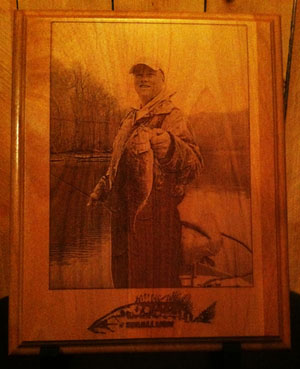
Congratulations to Keith on his personal best Smalljaw. This 5lb 6oz smallmouth was caught on a 4 inch swim bait out on the main lake. Keith is on of the best smallmouth fisherman I had had the pleasure of sharing the boat with. Keith, after spending a full 2 weeks on the Hollow is reporting fish are hitting grubs, swim baits, finess worms, spinnerbaits and jigs. Most fish are being caught on the main lake flats as well as some creeks. Lake is up to summer pool and won't be long before that night bite. Good luck ans see ya on the water. Ar
The first opportunity for fishermen to hit the water after dark in search of the elusive Dale Hollow smallmouth bass comes in May when the weather warms up enough for them to stand the cooler nighttime temperatures without wearing cumbersome cold-weather gear.
The most important thing to keep in mind when this time comes is SAFETY. There's nothing like watching smallmouth break water in the moonlight, but nothing is worth risking your life.
Your boat and gear needs to be in good working condition, because the lakes are totally different after dark. Running lights are a must and having your batteries fully charged is important in order to power the necessary electronics used when night fishing.
Especially in the early season when the water level is high, a powerful spotlight is needed to search for dangerous floating debris. Nothing is more frustrating than to have an equipment-damaging collision, which could put an end to any fishing trip.
It is also a good idea for a nocturnal angler to inform someone of their departure time, the area of the lake they plan on fishing, and when they may return from their night on the water.
Early Season
In May, when the early night fishing season begins, smallmouth with be in a post-spawn pattern. The fish will be feeding heavily and up shallow roaming the banks for anything they can find to eat.
The key to finding the bite is to start off in the feeder creeks, targeting areas from secondary points all the way to the back of these creeks. A focus should be put on points, cuts, and transitions--including areas close to the spawning flats with cover, such as wood or grass.
The utilization of a 1/4 oz. black hair jig trailed by a small plastic chunk with the tails tipped with garlic scent is a successful tactic during this early part of the season.
Fishermen should make a long cast up tight to the bank--close enough "to splash water on dry ground, “so to speak, and let the jig fall to the bottom.
Once the bait has sunk to the bottom, it is best to raise the jig about two feet with the rod and let it fall again. Be ready for a strike at all times, because smallmouth sometimes hit the jig on the cast or the first fall.
As the month progresses and the water temperature starts to rise, the fish will start moving a little deeper each week, but usually no farther than the eight to 12-foot range.
As the month of June arrives, smallmouth will start to move and may be found from the secondary creek points towards the main lake points. Some could even be found on creek and main lake bluff walls.
These fish will still be fairly shallow and in the eight to 15-foot range looking for areas abused by heavy daytime boat traffic, which creates stained water.
Sticking with the 1/4 oz hair jig, night fishermen will need to slow things down a bit and fish the jig all the way back to the boat in order to have success.
Mid-season
During the months of July, August, and September--most night fishermen's favorite time of year, air and water temperatures begin reaching summertime highs.
The daytime boat and Jet Ski traffic is also at its peak and boaters are churning up the lake, creating an abundance of stained water, especially out on the main body.
Besides that, those not on the water during the day are at home with the air conditioning turned up on high, forcing the TVA to crank up their power generators to keep up with the demand--creating a slight current in the river channel of the lake.
Smallmouth like current, even slight ones created by water being pulled through the dam, and they love to feed on crawfish in stained, churned-up water where the cover for their prey has been put in a state of disarray.
Night owls looking for the seasonally nocturnal smallmouth thrive during these three months thanks to the combination of these two bite-boosting factors.
This mid-season change signals a time to switch gears a little bit and start looking at the main lake with a 3/8 oz. hair jig in order to get down a little deeper. Fishermen should turn their focus toward deep water points, flats, and drops--all adjacent to the river channel.
By this point in the night fishing season, smallmouth have had sufficient time to start putting on some weight after the spawn and are healthy enough to become really upset when you stick them in the 15 to 35 feet depth range.
Late Season
As the after-dark season winds down during the month of October, the nights are starting to cool off a little. The fish have really put on the weight after feeding all summer and they are starting to move towards the fall pattern.
This is a time to start looking for fish both on the main lake and in feeder creeks. Smallmouth should be really schooled up during this time. If there is one fish there to be caught, then there are usually several more.
Moon phases
During the summer months, it seems better success comes during the new moon phase when only stars dominate the night sky, but don't overlook the full moon--which can also be very rewarding.
With the moon full, fishermen may want to look for places that are in the shade of the moon, even though some bites definitely come on a place that is directly in the path of the moonlight.
This was written in hopes of helping anglers out with their next adventure into the darkness of the night, and to encourage them to always remember to be safe.
Dale Hollow is a different lake once the sun goes down and the nocturnal life begins to awaken. Remember to take time to listen to all the different sounds Mother Nature has to offer and look up on occasion to view the heavens above in between bites, because you'll be glad you did!
Greg Brisendine
Dusk to Dawn Guide Service